

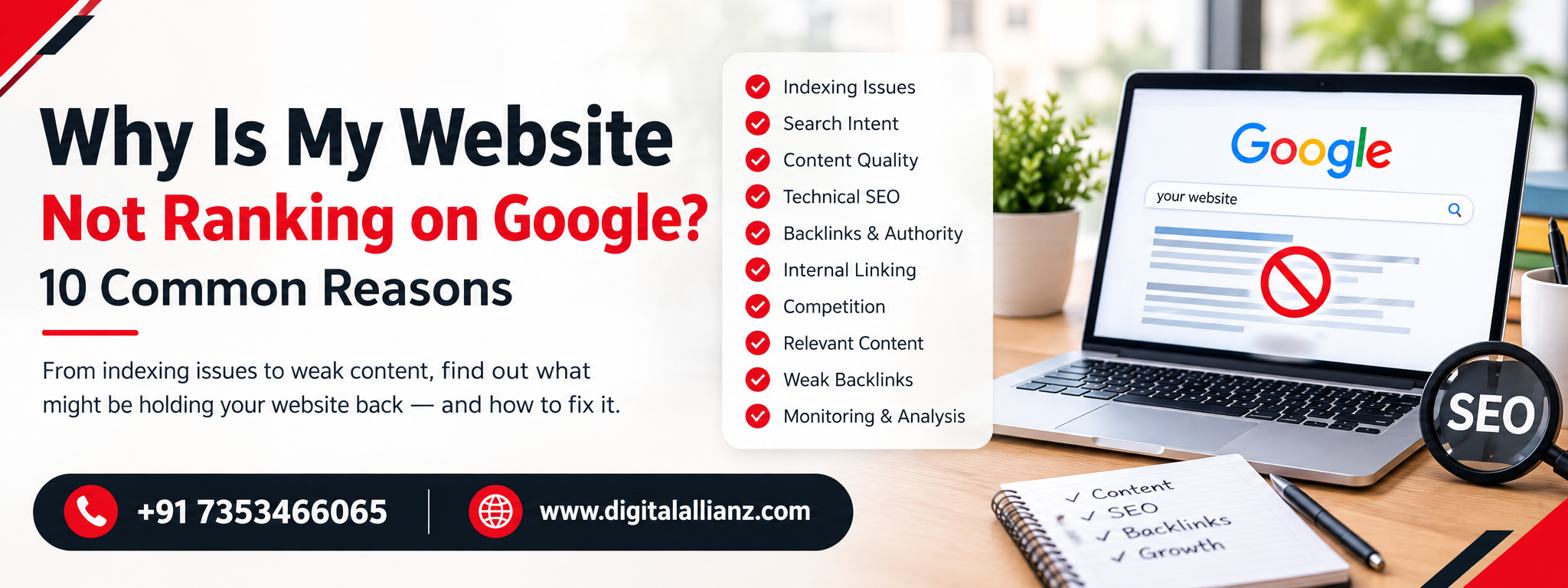
Why Is My Website Not Ranking on Google? 10 Common Reasons
Is your website not ranking on Google? Discover 10 common reasons, from indexing and keyword targeting to technical SEO, content quality, backlinks, internal linking, and competition. Learn how to identify ranking issues and improve your website’s search visibility with a focused SEO strategy.
Have you created a website but still cannot find it on Google? You may have invested time in designing your website, publishing content, and adding your products or services, but your pages may not appear when potential customers search for relevant terms. This can happen for several reasons, including technical problems, weak content, poor keyword targeting, limited authority, or indexing issues. Understanding the actual cause is the first step toward improving your website's visibility in search results.
1. Your Website Has Not Been Indexed by Google
Before a website can appear in Google search results, Google needs to discover and index its pages. A newly launched website may take time to be crawled and indexed. However, technical settings can also prevent Google from accessing important pages.
You can check whether your pages are indexed by using Google Search Console. If important pages are not indexed, check for issues such as incorrect noindex tags, blocked crawling, or other technical problems.
2. Your Keywords Do Not Match Search Intent
One common reason a website struggles to rank is targeting keywords without understanding what users actually want.
For example, someone searching for “how to improve website speed” is looking for information, while someone searching for “website development company” may be looking for a service provider. These are different search intents and require different types of pages.
Your content should match the reason behind the search. Informational questions are generally better suited to helpful blog content, while commercial searches should be targeted through relevant service or landing pages.
3. Your Content Is Not Providing Enough Value
Simply adding keywords to a page does not guarantee rankings. Google evaluates whether content is useful and relevant to the searcher's query.
If your page contains very little information, repeats the same ideas, or does not answer the user's question clearly, it may struggle to compete with more useful pages.
Instead of writing content only for search engines, focus on answering the user's actual problem. Explain the topic clearly, provide practical information, and make the page easy to understand.
4. Your Website Has Technical SEO Problems
Technical issues can affect how search engines crawl, understand, and index your website.
Common technical SEO problems include broken links, incorrect canonical tags, slow-loading pages, mobile usability issues, duplicate pages, missing metadata, and incorrect robots.txt settings.
Regular technical SEO checks can help identify problems that may otherwise remain unnoticed.
5. Your Website Is New and Has Limited Authority
New websites often need time to establish visibility in organic search. Even if the website has good content, it may have limited authority compared with established websites that have been publishing useful content for years.
Building authority is a gradual process. Creating valuable content, earning relevant backlinks, maintaining a strong internal linking structure, and consistently improving the website can help strengthen its overall search presence.
6. Your Pages Have Weak Internal Linking
Internal links connect different pages within your website. They help visitors discover related information and can also help search engines understand the relationship between your pages.
For example, an informational blog about why a website is not ranking could naturally link to a relevant SEO service page. This creates a useful journey from the user's question to a service that may address the underlying problem.
Internal links should be relevant and helpful rather than added simply to increase the number of links on a page.
7. Your Website Has Very Little Relevant Content
If your website has only a few pages covering a broad range of services or topics, Google may have limited information about what your business provides.
Creating useful, focused content around relevant customer questions can help build topical coverage. However, this does not mean publishing large amounts of repetitive content. Each page should have a clear purpose and provide something useful to the reader.
For example, instead of creating multiple pages targeting nearly identical keywords, you can create one useful resource that answers a specific customer question and supports the appropriate service page.
8. Your Website Has Weak or Irrelevant Backlinks
Backlinks can help search engines understand that other websites reference your content. However, the quality and relevance of links matter more than simply collecting a large number of backlinks.
Links from unrelated, low-quality, or suspicious websites may not provide meaningful value. A better approach is to focus on earning relevant links through useful content, legitimate business listings, industry resources, partnerships, and other appropriate methods.
9. Your Competitors Have More Relevant and Useful Pages
SEO is competitive. Your website is not ranking in isolation; other websites are competing for the same searches.
Competitor pages may have more comprehensive information, stronger authority, better technical performance, or content that matches the searcher's intent more effectively.
Reviewing the pages that currently appear for your target search can help you understand what type of content Google is showing and where your page may need improvement. The goal should be to provide a more useful and relevant experience rather than simply copying competitor content.
10. Your Website Has Not Been Properly Monitored
SEO requires ongoing monitoring. A website can experience ranking changes because of technical issues, content changes, indexing problems, search algorithm updates, or increased competition.
Tools such as Google Search Console and analytics platforms can help you understand impressions, clicks, search queries, indexing status, and website performance.
Instead of guessing why your website is not ranking, use available data to identify the specific problem and then make targeted improvements.
How Can You Find the Real Reason Your Website Is Not Ranking?
If you are still not able to find the exact reason why your website is not ranking on Google, Digital Allianz, an affordable digital marketing agency, can help. Our team can analyse your website, identify the key SEO issues, and help improve your website’s search visibility with the right digital marketing strategy.
How Can SEO Help Improve Website Rankings?
SEO brings together several activities, including technical optimisation, keyword research, content development, on-page optimisation, internal linking, off-page activities, and performance monitoring.
The right approach depends on why the website is struggling. Fixing a technical indexing problem requires a different solution from improving weak content or targeting the wrong search intent.
A focused SEO strategy can help businesses improve their website structure, content relevance, search visibility, and overall organic presence.
Frequently Asked Questions
Why is my website not showing on Google?
Your website may not be appearing because it has not been indexed, has technical SEO problems, targets the wrong search intent, has weak content, or has limited authority.
How long does it take for a website to rank on Google?
There is no fixed timeframe. Results can depend on factors such as competition, website history, content quality, technical condition, authority, and the search terms being targeted.
How can I check if Google has indexed my website?
Google Search Console can help you check indexing status and identify pages that Google has discovered, indexed, or excluded.
Can backlinks improve my Google rankings?
Relevant, quality backlinks can contribute to a website's authority, but backlinks alone do not guarantee higher rankings. Content quality, relevance, technical SEO, and search intent also matter.
Should I create more blog posts if my website is not ranking?
Not necessarily. First identify the actual problem. If the issue is technical SEO, indexing, search intent, or weak existing content, publishing more blogs may not solve it. Each new blog should have a clear informational purpose and should support the appropriate existing page.
Final Thoughts
If your website is not ranking on Google, the solution is not always to publish more content or add more keywords. Start by identifying the actual reason your pages are not performing. Check indexing, search intent, content quality, technical SEO, internal linking, backlinks, competition, and performance data.
A useful SEO strategy focuses on solving the user's search need first and then connecting that helpful content to the relevant service or business page. This creates a clearer journey from Google Search → Helpful Content → Relevant Service Page → Enquiry.