
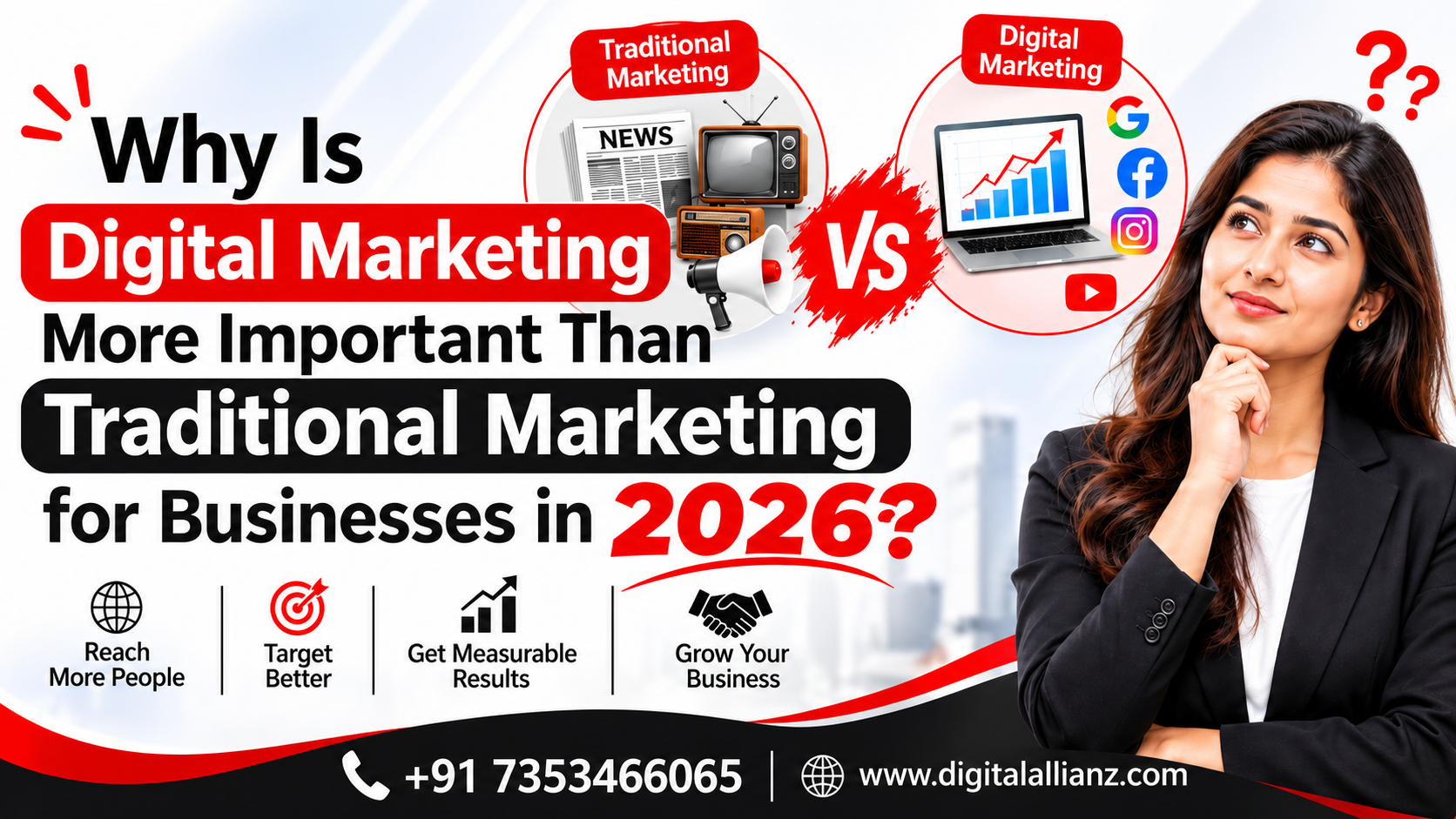
Why Is Digital Marketing More Important Than Traditional Marketing for Businesses in 2026?
Discover why digital marketing is more important than traditional marketing for businesses in 2026. Explore SEO, social media, online advertising, customer engagement and strategies to improve business visibility.
Introduction
The way businesses connect with customers has changed significantly over the years. Earlier, companies mainly depended on newspapers, television advertisements, radio, banners and brochures to promote their products and services. These traditional marketing methods helped businesses build brand awareness and reach local audiences.
However, customer behaviour has changed with the growth of smartphones, internet access and online platforms. Today, people search on Google, explore social media, read online reviews and compare products before making purchasing decisions.
This shift has made digital marketing an important part of modern business strategies. In 2026, businesses need to understand how online platforms influence customer decisions and how digital marketing strategies can help them reach relevant audiences, improve visibility and build stronger customer relationships.
1. Wider Audience Reach Through Online Platforms
Traditional marketing generally depends on geographical locations and selected advertising channels. For example, a newspaper advertisement may reach readers in a particular region, while a television advertisement targets audiences watching a specific channel.
Digital marketing allows businesses to reach people across different cities, states and countries through websites, search engines and social media platforms.
Businesses can connect with potential customers based on their interests, locations, search behaviour and preferences.
This wider reach helps companies introduce their products and services to audiences who may not have discovered them through traditional advertising.
2. Better Audience Targeting
One of the major differences between traditional and digital marketing is audience targeting.
Traditional advertising often reaches a broad audience, even when some viewers or readers may not be interested in the advertised product.
Digital marketing provides more targeted options. Businesses can reach audiences based on:
- Age groups and interests.
- Geographic locations.
- Online behaviour.
- Search queries and keywords.
- Previous website interactions.
For example, a dental clinic can use location-based advertising to reach people searching for dental services in its surrounding area.
This approach helps businesses focus their marketing activities on audiences who are more likely to be interested in their products or services.
3. More Measurable Marketing Results
Measuring advertising performance is important for understanding whether marketing activities are producing useful results.
With traditional marketing, it can be difficult to identify exactly how many people visited a business after seeing a newspaper advertisement or billboard.
Digital marketing provides several tools to monitor campaign performance.
Businesses can analyse:
- Website visitors.
- Search impressions and clicks.
- Advertising costs.
- Customer enquiries.
- Conversion rates.
- Social media engagement.
Tools such as Google Analytics 4 and Google Search Console help businesses understand website traffic, search performance and user behaviour.
These insights allow marketers to identify what is working, understand performance changes and make informed improvements.
4. Flexible Marketing Budgets
Traditional advertising methods such as television commercials, newspaper advertisements and outdoor banners may require considerable investment.
Digital marketing offers different budget options depending on business requirements.
Small businesses can begin with organic activities such as SEO, content creation and social media marketing. Businesses looking for faster visibility can also explore paid advertising through platforms such as Google Ads and Meta Ads.
Marketing budgets can be adjusted based on campaign performance, business objectives and available resources.
However, digital marketing is not automatically inexpensive. Effective campaigns still require proper planning, quality content, technical improvements and ongoing optimisation.
5. Building Customer Trust Through Online Presence
Before choosing a product or service, customers often research businesses online.
They may visit a company's website, read customer reviews, check social media profiles and compare available options.
A professional online presence helps businesses provide useful information and communicate their expertise.
For example, regularly publishing informative blogs can answer customer questions, while maintaining an updated Google Business Profile can help people find relevant business information.
Customer reviews, helpful website content and consistent communication also contribute to building credibility.
Traditional marketing can introduce a brand, but digital platforms provide more opportunities for customers to explore and interact with it.
6. Search Engine Visibility Through SEO
Search engines play an important role in how customers discover businesses.
When someone searches for a product, service or solution on Google, websites with relevant and useful information have opportunities to appear in search results.
Search Engine Optimisation (SEO) helps businesses improve their organic search visibility through activities such as:
- Keyword research.
- Quality content creation.
- On-page optimisation.
- Technical SEO improvements.
- Relevant backlink building.
- Local SEO optimisation.
SEO is a long-term marketing activity. It does not guarantee immediate rankings, but consistent improvements can help businesses attract relevant organic traffic over time.
Businesses interested in improving their search performance can explore SEO and digital marketing services to understand different approaches to building online visibility.
7. Direct Customer Engagement Through Social Media
Traditional advertising generally communicates messages from businesses to audiences, with limited opportunities for immediate interaction.
Social media platforms offer more direct communication.
Businesses can share updates, publish educational content, respond to customer questions and receive feedback through comments and messages.
Platforms such as Instagram, Facebook and LinkedIn also allow businesses to communicate with different audience groups.
For example, a restaurant can share menu updates, a training institute can publish educational information, and a service company can explain how its services solve customer problems.
Regular and meaningful communication helps businesses maintain relationships with their audiences.
8. Understanding Customer Behaviour
Understanding customer behaviour helps businesses make better marketing decisions.
Digital platforms provide information about what customers search for, which pages they visit, what content they engage with and where they leave a website.
By studying these patterns, businesses can identify customer interests and areas that need improvement.
For example, if a website receives many visitors but very few enquiries, the business can review its page content, navigation, loading speed and contact options.
This information helps marketers improve the customer experience instead of relying entirely on assumptions.
9. The Growing Role of AI in Digital Marketing in 2026
Artificial intelligence is becoming an important part of modern marketing activities.
Businesses and marketers are exploring AI-powered tools for content research, customer behaviour analysis, campaign planning and data interpretation.
Search experiences are also evolving. Customers increasingly use AI-powered platforms to discover information, explore products and find answers to questions.
This creates new opportunities for businesses to focus on helpful, accurate and well-structured content.
Along with traditional SEO practices, businesses can pay attention to Answer Engine Optimisation (AEO) and Generative Engine Optimisation (GEO) to improve how their information is understood and discovered across different search experiences.
AI tools can support marketing activities, but human review, accuracy and a clear understanding of customer needs remain essential.
10. Why Businesses Should Combine Digital and Traditional Marketing
Although digital marketing offers several advantages, traditional marketing has not completely lost its importance.
Newspaper advertisements, brochures, television campaigns and outdoor advertising can still help businesses connect with specific audiences.
The right marketing approach depends on the business type, target audience, available budget and campaign objectives.
For example, a local retail store may use outdoor banners to attract nearby customers while maintaining an online presence through Google Business Profile and social media.
Similarly, a large company may combine television advertising with digital campaigns to increase brand awareness across multiple channels.
Rather than treating these approaches as competitors, businesses can use them together when appropriate.
Conclusion
Marketing continues to evolve as technology and customer expectations change. Traditional marketing still has a role in brand communication, but digital platforms provide businesses with additional opportunities for audience targeting, performance measurement, customer engagement and online visibility.
In 2026, businesses need to understand where their customers spend time, how they search for information and what influences their purchasing decisions.
A well-planned digital marketing strategy that includes SEO, content marketing, social media and online advertising can help businesses build a stronger online presence and adapt to changing customer behaviour.
Businesses can explore Digital Marketing Services to understand how different online marketing strategies can support their business objectives.
Frequently Asked Questions
1. Why is digital marketing important for businesses in 2026?
Digital marketing helps businesses reach online audiences, improve search visibility, understand customer behaviour and measure marketing performance.
2. Is traditional marketing still useful in 2026?
Yes. Traditional marketing can still support brand awareness through newspapers, television, radio and outdoor advertising, particularly when targeting specific audiences.
3. Which is more cost-effective, digital or traditional marketing?
Digital marketing offers flexible budget options and measurable results. However, actual costs depend on the marketing channel, competition and campaign objectives.
4. Can small businesses benefit from digital marketing?
Yes. Small businesses can use SEO, social media, content marketing and local search optimisation to improve their online visibility and connect with potential customers.
5. What are the main types of digital marketing?
The main types include SEO, PPC advertising, social media marketing, content marketing, email marketing and local SEO.