
How to Track the ROI of My Google Ads Campaigns as a Photographer?
Learn how photographers can track Google Ads ROI by measuring leads, bookings, revenue, ROAS and lead quality. Discover practical ways to connect Google Ads with GA4 and CRM data to understand which campaigns generate real business results.
How to Track the ROI of My Google Ads Campaigns as a Photographer?
For a photography business, running Google Ads is not just about getting clicks or bringing more visitors to your website. The real goal is to generate qualified enquiries, photography bookings and profit.
A campaign can produce hundreds of clicks and still fail to generate customers. Another campaign may receive fewer enquiries but bring several high-value wedding or commercial photography bookings.
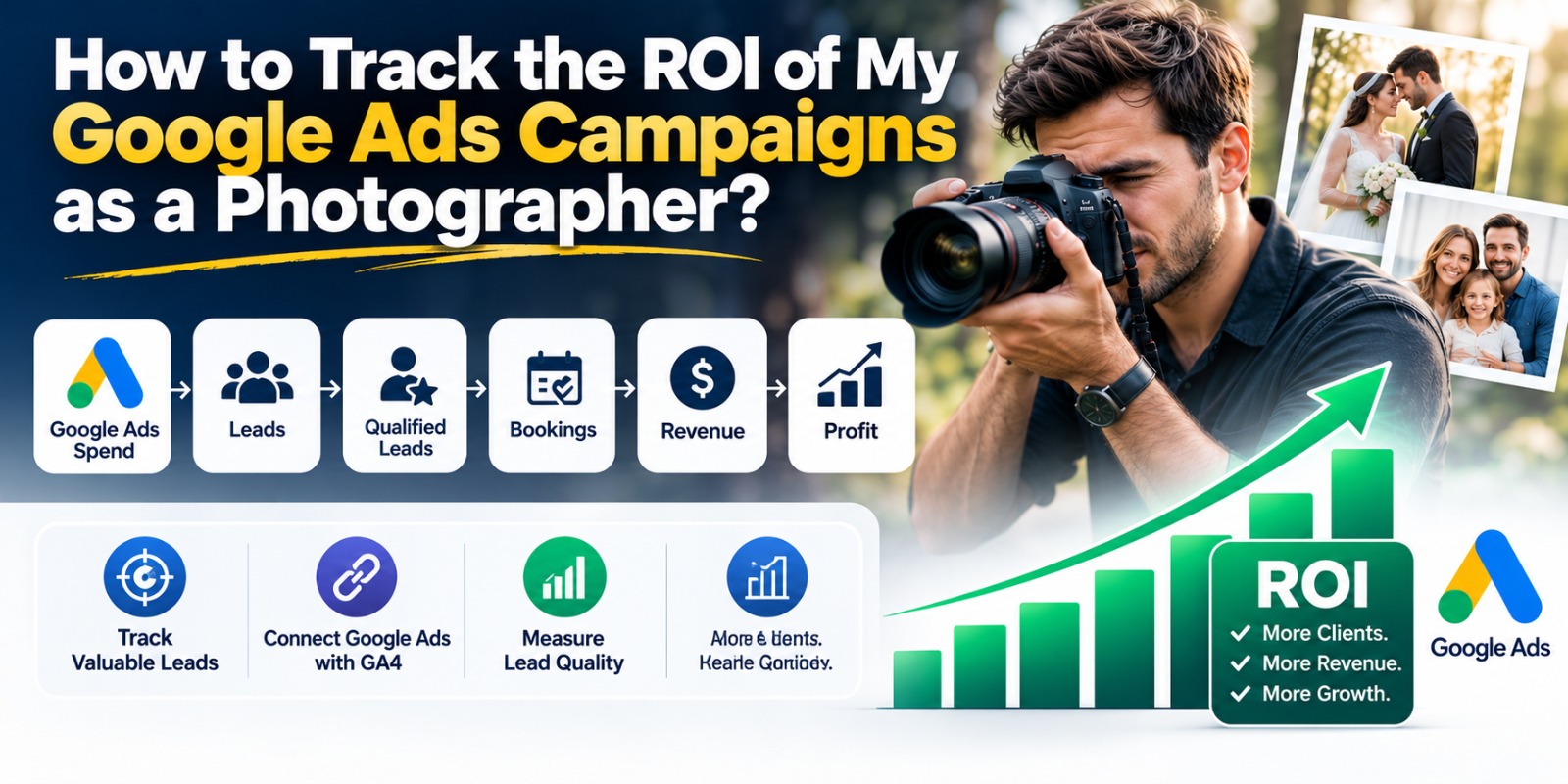
That is why photographers should track the complete journey:
Google Ads Spend → Leads → Qualified Leads → Bookings → Revenue → Profit
When you connect these numbers, you can understand which campaigns are actually contributing to your business and where your advertising budget can be improved.
1. Track Every Valuable Lead
Start by identifying the actions that matter to your photography business. Depending on how you accept enquiries, these might include contact form submissions, phone calls, WhatsApp enquiries, consultation requests, quote requests or online deposits.
Google Ads conversion tracking can help you identify which advertising interactions lead to valuable actions.
However, don't treat every interaction as equally valuable. Someone who visits your portfolio for a few seconds is different from someone who asks about your availability for a wedding date.
The goal is to track actions that have a genuine connection to becoming a paying client.
2. Connect Google Ads With GA4
Google Ads shows you how your advertisements are performing, while Google Analytics 4 (GA4) can provide additional information about what visitors do after reaching your website.
Connecting the two can help you understand how people interact with your photography website after clicking an advertisement. You can see which pages they visit, whether they engage with your portfolio and whether they complete important actions.
For example, you might discover that visitors from one campaign spend more time viewing your wedding photography page and are more likely to submit an enquiry.
This information can help you improve both your advertising campaigns and your website.
3. Assign a Value to Your Leads
Many photographers don't receive payment immediately after someone clicks an ad. A potential client may submit an enquiry, compare photographers, discuss packages and make a booking later.
You can estimate the average value of a lead using your previous booking data.
For example:
- Average wedding booking: $3,500
- Percentage of enquiries that become clients: 20%
- Estimated value of one enquiry: $700
The $700 isn't the guaranteed value of every enquiry. It is an estimated average that can help you compare campaigns and understand which leads have greater potential.
As you collect more actual booking data, you can make your estimates more accurate.
4. Calculate Your Actual ROI
Once you know your advertising costs and the revenue generated from customers acquired through Google Ads, you can calculate ROI.
A simple formula is:
ROI = (Revenue − Costs) ÷ Costs × 100
For example:
Metric
Value
Google Ads spend
$800
Leads generated
16
Clients booked
4
Average booking value
$1,200
Revenue generated
$4,800
Advertising ROI
500%
The calculation is:
($4,800 − $800) ÷ $800 × 100 = 500%
This is a simplified advertising ROI calculation. For a more accurate picture of profitability, also consider costs associated with delivering the photography service, such as editing, travel, albums, assistants and second photographers.
5. Understand ROAS vs. ROI
ROAS, or Return on Ad Spend, measures the revenue generated compared with your advertising spend.
ROAS = Revenue ÷ Advertising Spend
Using the previous example:
$4,800 ÷ $800 = 6:1
This means the campaign generated $6 in tracked revenue for every $1 spent on Google Ads.
ROI is broader because it considers costs when determining the financial return.
For photographers, both metrics are useful. ROAS helps you understand advertising efficiency, while ROI helps you understand profitability.
A campaign can have a strong ROAS but still produce less profit than expected if the cost of delivering the photography service is high.
6. Track ROI by Photography Service
If you offer multiple photography services, measure their performance separately where practical.
Wedding photography, family portraits, headshots and commercial photography can have very different booking values and conversion rates.
For example:
Photography Service
Leads
Bookings
Revenue
Wedding Photography
20
4
$14,000
Family Portraits
35
10
$7,500
Commercial Photography
12
3
$6,000
The family portrait campaign generated the most leads, but wedding photography produced the highest revenue.
This type of comparison helps you decide which services are generating the strongest return and where additional advertising budget may make sense.
7. Measure Lead Quality, Not Just Lead Quantity
A campaign that generates 50 enquiries isn't automatically better than one that generates 20.
Look at what happens after those enquiries arrive.
Useful metrics include cost per lead, lead-to-booking rate, cost per booking, revenue per campaign and ROAS.
For example, Campaign A may generate 40 leads at $20 each, while Campaign B generates 15 leads at $50 each.
Campaign A appears cheaper. But if only two Campaign A leads become customers while five Campaign B leads book higher-value packages, Campaign B may be much more profitable.
For photographers, the quality of leads matters more than the number of leads alone.
8. Connect Google Ads With Your CRM
If you use a client management system such as HoneyBook, Dubsado or Studio Ninja, record where each enquiry came from and whether it eventually became a paying customer.
This helps close the gap between advertising data and actual business results.
Instead of seeing:
Google Ads → 16 enquiries
you can see:
Google Ads → 16 enquiries → 7 qualified leads → 4 bookings → $4,800 revenue
That gives you a much clearer understanding of the value generated by your advertising.
If clients usually contact you by phone, email or messaging before booking, include those interactions in your lead-management process where possible.
Get Help Tracking Your Google Ads ROI
Tracking Google Ads ROI becomes easier when your advertising data, website analytics and customer enquiries are properly connected. For photographers, setting up conversion tracking, analysing lead quality and understanding which campaigns generate actual bookings can take time.
For photographers who need support with this process, DigitalAllianz offers digital marketing solutions focused on measurable results, including Google Ads management, conversion tracking, website performance and lead generation. Our approach focuses on connecting marketing efforts with meaningful business outcomes rather than simply measuring clicks and impressions.
With the right tracking and reporting in place, photographers can understand which campaigns generate valuable enquiries, which leads turn into bookings and where their advertising budget can deliver stronger returns.
A Simple Monthly ROI Check for Photographers
You don't need to monitor every available Google Ads metric. Focus on numbers that connect advertising activity with business results.
Metric
What It Tells You
Ad Spend
How much you invested
Leads
Number of enquiries generated
Qualified Leads
Number of genuine prospects
Bookings
Customers acquired
Cost Per Booking
Cost of acquiring each customer
Revenue
Income generated from those customers
ROAS
Revenue compared with ad spend
ROI
Overall financial return
Review these numbers regularly rather than focusing on one metric in isolation.
Common Google Ads ROI Mistakes Photographers Should Avoid
One common mistake is focusing only on clicks and impressions. These numbers show activity, but they don't tell you whether people actually hired you.
Another mistake is treating every enquiry as equally valuable. A potential wedding client and someone simply asking for general information can have very different business value.
Photographers can also miss valuable conversions by tracking only website forms. If clients frequently call or message you, those enquiries should be included in your measurement wherever possible.
Finally, don't choose campaigns based only on the lowest cost per lead. A more expensive lead can be much more valuable if it consistently turns into a higher-paying customer.
Frequently Asked Questions
How do I track the ROI of Google Ads as a photographer?
Track your Google Ads spend, valuable enquiries, qualified leads, confirmed bookings and revenue. Then compare the revenue or profit generated by those customers with the costs associated with acquiring them.
What is a good ROI for Google Ads for a photographer?
There is no single ROI target that works for every photographer. Your ideal return depends on your average booking value, profit margin, service costs, competition and customer acquisition cost.
Should photographers track ROAS or ROI?
Ideally, track both. ROAS shows the revenue generated from advertising compared with ad spend, while ROI provides a broader view of profitability after relevant costs.
What Google Ads conversions should photographers track?
Useful conversions can include contact forms, phone calls, WhatsApp enquiries, consultation bookings, quote requests and confirmed photography bookings. Focus on actions that have a meaningful connection to your business.
How do I calculate cost per photography booking?
Divide your Google Ads spend by the number of confirmed bookings generated through those campaigns.
Cost Per Booking = Google Ads Spend ÷ Number of Bookings
For example, if you spend $1,000 and acquire five customers, your cost per booking is $200.
Why am I getting lots of Google Ads leads but few bookings?
Check your lead quality, keywords, search intent, landing page, pricing, packages, availability and follow-up process. The problem may be somewhere in the customer journey rather than the advertisement itself.
Should I track ROI separately for weddings and portraits?
Yes. Different photography services can have different booking values and conversion rates. Separating them can help you identify which services are generating the strongest return.
Can I track a client who discovers me through Google Ads but books later?
Yes. By recording the original lead source in your CRM or lead-management process, you can connect an initial Google Ads enquiry with a later consultation or booking. This gives you a clearer picture of the campaign's actual revenue contribution.
Final Thoughts
Tracking Google Ads ROI as a photographer doesn't have to be complicated. The key is to move beyond clicks and connect your advertising with real clients and real revenue.
Start by tracking valuable enquiries, connect your advertising with GA4 and your CRM where appropriate, measure which leads become bookings, and calculate the revenue generated from those customers.