
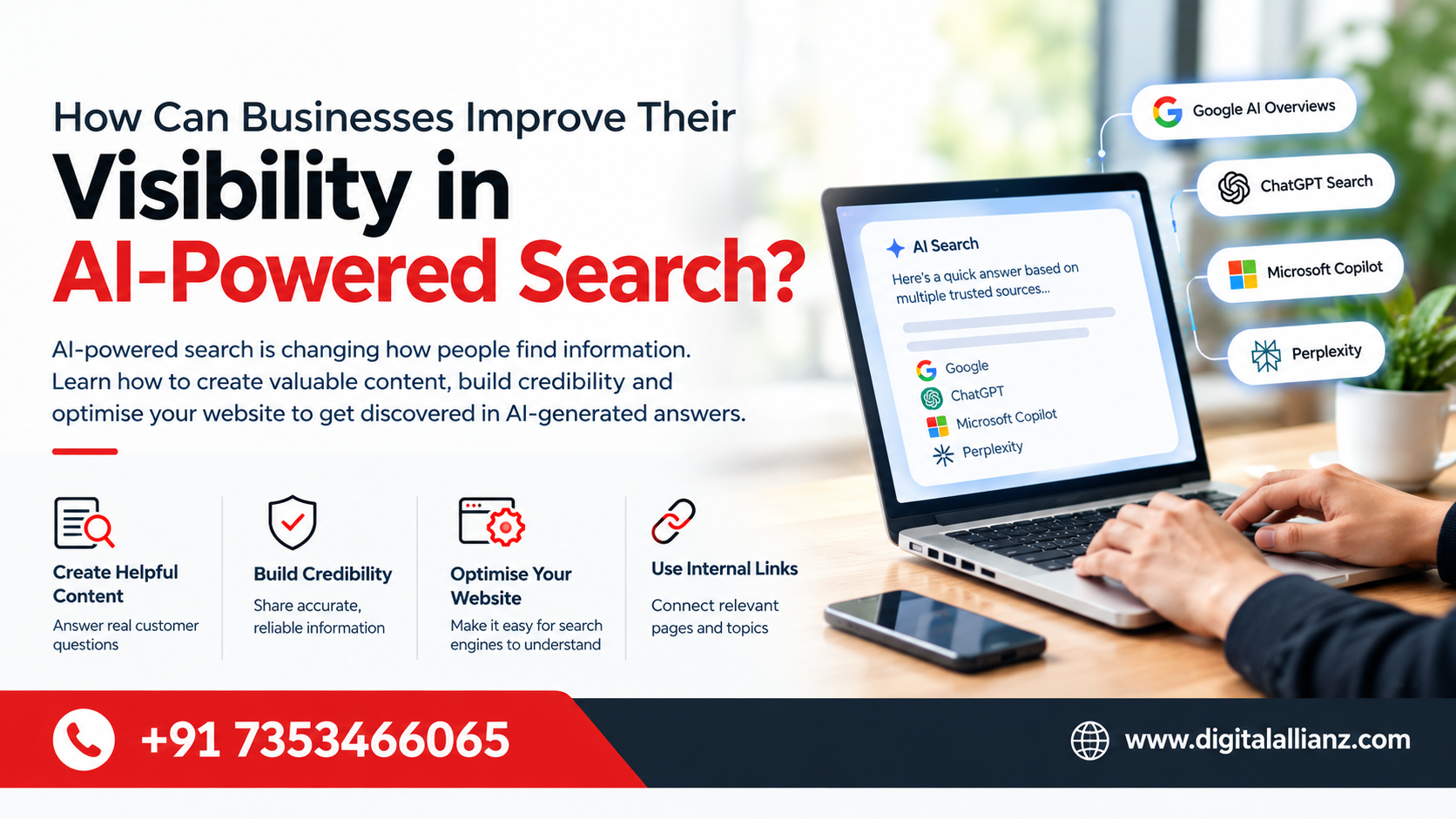
How Can Businesses Improve Their Visibility in AI-Powered Search?
Discover how businesses can improve AI-powered search visibility with SEO best practices, quality content, and effective website optimisation strategies.
Search engines are changing how people discover information online. Along with traditional search results, users can now find AI-generated answers that summarise information from different sources. These developments create new opportunities for businesses to reach audiences through AI-powered search experiences.
However, appearing in AI-generated answers requires more than adding keywords to a website. Businesses need to publish useful information, maintain a technically accessible website, and demonstrate genuine knowledge of their industry.
Understanding AI search visibility can help businesses adapt their content strategies and make their information easier for search engines and potential customers to discover.
1. Understand How AI-Powered Search Works
Traditional search engines display relevant web pages, while AI-powered search experiences can generate summaries and conversational answers using information from multiple sources.
Platforms such as Google AI Overviews, ChatGPT search, Microsoft Copilot, and Perplexity provide different ways for users to discover information.
These platforms use different systems to retrieve and present information. Therefore, no single technique guarantees that a website will appear in every AI-generated answer.
Businesses should focus on creating helpful content, providing accurate information, and making their web pages accessible to search engines.
2. Create Content That Answers Customer Questions
People frequently search online with questions about products, services, and business decisions. Creating content that directly addresses these questions can help businesses provide useful information to their audiences.
For example, businesses can publish educational articles, practical guides, comparisons, and frequently asked questions related to their industries.
A company offering digital marketing services could explain how keyword research works, how website performance is measured, or how businesses can improve their online presence.
To improve AI search optimisation, each article should focus on a specific topic and provide a clear, informative answer. Supporting explanations and relevant examples can make the content more useful.
Avoid publishing multiple articles that cover the same subject without offering additional value. Every page should have a distinct purpose and answer the reader's question effectively.
3. Organise Website Content With Clear Headings
A well-structured website helps visitors find information and makes it easier for search engines to understand individual pages.
Use one main H1 heading followed by relevant H2 and H3 headings. Keep paragraphs focused, explain technical concepts clearly, and organise related information into logical sections.
For example, an article about online visibility could include sections covering technical SEO, content quality, internal linking, and performance measurement.
Important information should be available as readable text rather than being presented exclusively in images or inaccessible interactive elements.
Clear headings and logical content organisation improve usability, although they do not guarantee inclusion in AI-generated answers.
4. Strengthen Traditional SEO Foundations
Traditional search engine optimisation remains important for businesses looking to improve their presence in AI-powered search experiences.
Search engines need to discover, crawl, and understand web pages before they can consider them for search results. Technical problems can prevent valuable content from being accessed or indexed.
Businesses should review the following areas:
- Technical SEO: Check crawling, indexing, and website accessibility.
- Mobile optimisation: Ensure the website works properly across different screen sizes.
- Page speed: Improve loading performance and reduce unnecessary scripts.
- Internal linking: Connect related pages using relevant anchor text.
- On-page SEO: Use accurate titles, headings, and descriptions.
- Structured data: Implement appropriate markup that accurately represents visible page content.
These SEO best practices help create a strong website foundation. However, technical improvements alone cannot guarantee visibility in AI-generated answers.
Businesses should combine technical improvements with useful, original, and reliable content.
5. Build Credibility Through Accurate and Helpful Information
Businesses can demonstrate their subject knowledge by publishing information that reflects genuine industry experience.
Instead of relying on general statements, explain processes, answer common questions, provide relevant examples, and support factual claims with reliable sources.
For example, an article about digital marketing performance could explain the differences between impressions, clicks, conversion rates, and leads.
Author information, accurate company details, relevant case studies, and transparent explanations can also help readers assess the credibility of a website.
Avoid unsupported statistics, exaggerated promises, and outdated information. Regular content reviews help businesses maintain accuracy and usefulness.
Building credibility takes time, and no website can guarantee that AI platforms will select its content as a source.
6. Use Internal Links to Connect Relevant Pages
Internal linking helps visitors discover related information and allows search engines to understand the relationships between pages on a website.
For example, an educational article about keyword research could link naturally to a relevant SEO service page. Readers who want professional assistance can then explore the service in more detail.
The anchor text should describe the destination accurately. Avoid forcing keywords into sentences or adding unnecessary links.
External links to reliable research, official documentation, and relevant industry resources can also support the information presented in an article.
A well-connected website provides a better user experience and helps search engines discover relevant content.
7. Use Structured Data Where Appropriate
Structured data provides additional context about the information presented on a web page.
Depending on the content, businesses may use suitable schema types for articles, organisations, products, or local business information.
For example, Article schema can describe an educational blog post, while Organisation schema can provide structured information about a business.
The markup should accurately match the visible content and follow applicable search engine guidelines.
Although structured data helps search engines interpret information, it does not guarantee higher rankings or inclusion in AI-generated answers.
Businesses should treat it as one component of a broader AI search visibility strategy, alongside technical SEO, accurate information, and helpful content.
8. Monitor Search Performance and Improve Content
Improving online visibility requires ongoing monitoring. Businesses should evaluate how their content performs and identify areas that need improvement.
Useful indicators include:
- Organic clicks and impressions in Google Search Console.
- Search queries that bring visitors to the website.
- Keyword ranking changes for relevant topics.
- Website engagement and conversions in analytics tools.
- Referral traffic from AI platforms, where available.
- Mentions or citations in AI-generated answers.
Businesses can use these insights to identify successful topics and improve pages that do not meet audience expectations.
For example, a page receiving impressions but few clicks may need a clearer title or description. A page attracting visitors but generating little engagement may need more relevant information or a better content structure.
Consistent measurement helps businesses make informed decisions instead of relying on assumptions about what improves search visibility.
9. How Digital Allianz Can Help Businesses Improve Online Visibility
Businesses looking to strengthen their online presence need a strategy that combines technical improvements, useful content, and an understanding of how people search for information.
Digital Allianz works in the digital marketing field, where services such as search engine optimisation, content development, and website optimisation can support businesses in improving their online presence.
A structured approach can include reviewing website performance, identifying relevant search topics, improving existing content, and strengthening internal links between related pages.
Businesses can also monitor search performance regularly to understand which pages attract visitors and where further improvements may be useful.
The right strategy depends on each business's website, audience, objectives, and existing search performance. Consistent optimisation and useful content provide a practical foundation for adapting to changes in search behaviour.
Frequently Asked Questions
What is AI-powered search visibility?
AI-powered search visibility refers to how easily people can discover a business's content through AI-assisted search experiences, including AI-generated answers and summaries that may link to relevant websites.
How can businesses improve their visibility in AI search results?
Businesses can focus on helpful content, technical SEO, accurate information, clear website structure, and relevant internal links. These practices improve discoverability, but they cannot guarantee inclusion in AI-generated answers.
Is traditional SEO still important for AI-powered search?
Yes. Traditional SEO practices, including crawlability, indexing, useful content, and internal linking, remain important for helping search engines discover and understand website pages.
Does AI search optimization require a separate SEO strategy?
Not necessarily. Businesses can build on established SEO practices while adapting their content to answer customer questions clearly. Google recommends focusing on its existing SEO fundamentals rather than relying on special AI optimisation tricks.
How can businesses measure AI search visibility?
Businesses can monitor organic search performance, available AI search reporting, referral traffic, and mentions or citations in AI-generated answers. The metrics available depend on the platform.
Conclusion
Improving visibility in AI-powered search starts with providing useful answers, maintaining an accessible website, and publishing reliable information.
Businesses should focus on AI-powered search, content quality, technical SEO, and a clear internal linking structure rather than relying on shortcuts or guaranteed-ranking promises.
By monitoring performance and continuously improving their content, businesses can adapt to changing search behaviour and create more opportunities for people to discover their websites.